MoreExam
1. Question Content...
EXPLANATION
Answer: X - EXPLANATION Content.
Question1: An organization has carried out a risk assessment for a project.Which of the following possible outcomes are examples of upside risk?Select ALL that apply.
Question2: An organization's transfer pricing system involves:* The transferring division receiving $20 per unit; an amount equal to its variable costs.* The receiving division paying an additional $30,000 every month to the transferring division.Which transfer pricing system is the organization using?
Question3: A division of company XYZ has reported an operating profit of $350,000 and its residual income (RI) has been calculated as $60,000. The company's cost of capital is 12%.The division's return on investment (ROI) is:
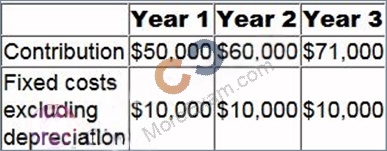
Question4: The following forecast data relate to the first three years of a five year project.The project will require an initial investment of $30,000 in non-current assets.All revenue will be received in the year it is earned and all operating costs will be paid in the year they are incurred. Tax will be paid in the following year.Tax depreciation will be 25% per annum of the reducing balance.The taxation rate will be 30% of taxable profits.What is the forecast after tax cash flow for year 3 (to the nearest $10)?
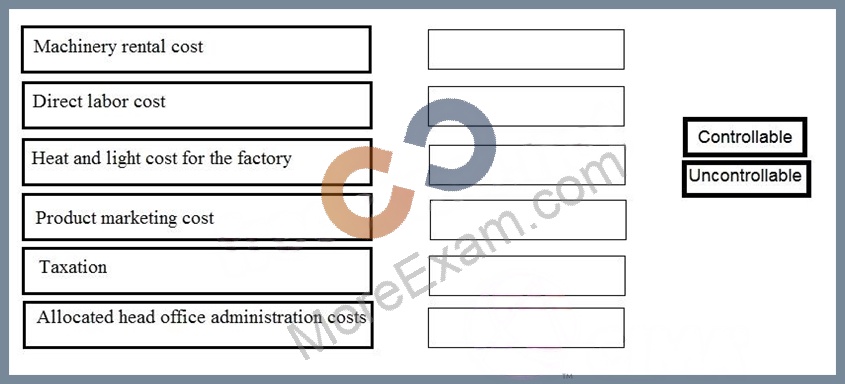
Question5: A company classifies its main factory as an investment centre. Categorise each of the following costs as either controllable or uncontrollable by the investment centre manager.
Question6: Which of the following statements is correct in respect of the key feature of dual pricing?
Question7: One of an investment centre's products is sold on an external market. Output is limited because the specialist machine that manufactures the product is operating at full capacity.Current data for the product are as follows.Investigations have identified that more rigorous maintenance of the machine at an annual cost of$5,000 would reduce the number of breakdowns and increase its capacity to 1,300 units per year.There would be no change in the selling price if more units were sold. Any additional labor hours would be paid a premium of 25%. A discount of 2% of the cost of all materials purchased is available if the company increases its purchases to 3,700 kg or more per year.What would be the increase in the investment centre's annual controllable profit if more rigorous maintenance is undertaken?
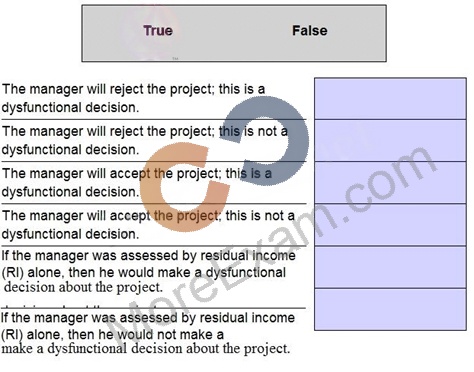
Question8: The performance of an investment centre manager is assessed by return on investment (ROI) alone. At present, his expected ROI for next year is 15%. The manager must now decide whether to invest in a new project that is expected to yield an ROI of 14%. The cost of capital is 12%.Indicate whether each of the following statements is true or false.
Question9: LL produces an item, the Z, for which the demand curve is estimated to be:P = 10 - 0.0001Qwhere, P is the unit price in $ and Q is the annual sales volume in units; Marginal revenue (MR) = 10 - 0.0002Q The variable cost of producing the Z is $2 per unit. The annual fixed costs of production are $110,000.What is the profit maximizing output level?
Question10: ZZZ is a divisionalised company that uses the balanced scorecard approach to monitor divisional performance. Each measure on the scorecard is classified as green (if they are better than expected), amber (if expectations have been met) or red (if they are poorer than expected).The Southern Division's scorecard shows that 90% of the measures are amber, 3% are green and 7% are red.All of the red classifications are listed under the Learning and Growth perspective and have arisen largely because the division has lost a lot of staff to a major competitor who offered a better rate of pay.Which THREE of the following statements are correct?
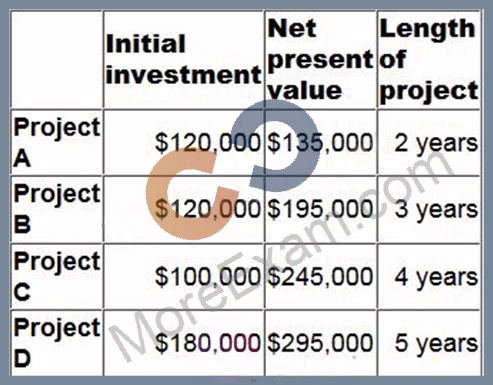
Question11: The following data are available for four projects with unequal lives.A 10% discount rate is appropriate for all four projects.Which project has the highest equivalent annual benefit?
Question12: You have just assessed an investment proposal, involving an immediate cash outflow followed by a series of cash inflows over the next 7years, by deducing the NPV and the IRR. You have now discovered that you have underestimated the discount rate.Correcting the underestimation will have the following effect, relative to your original deductions:
Question13: A positive net present value (NPV) has been calculated for a project to launch a new product. An additional calculation is required to identify the sensitivity of the NPV to changes in the forecast total sales volume.The present value of which of the following would be used in the calculation?
Question14: Division A is an investment centre with assets of $7.3 million. The following is an extract from the annual budget for division A:The cost of capital is 14%.Calculate the residual income for division A.
Question15: A not-for-profit organization measures performance using the three Es. If the organization has made optimum utilization of available resources then it should be described as:
Question16: Company TTM has the opportunity to invest $60,000 in a project. The project is anticipated to produce annual returns of $12,500 each year for 8 years. The cost of capital is 12%.What is the net present value of the project? Give your answer to the nearest whole number.
Question17: A company is considering the replacement of its outdated information system.Which of the following are appropriate approaches for the company to take to assess the potential qualitative benefits of a replacement information system?(1) Ignore the qualitative benefits that may arise because there is too much subjectivity involved in their assessment.(2) Attempt to attribute monetary values to each of the qualitative benefits identified.(3) Acknowledge the existence of qualitative benefits and attempt to assess them in a reasonable manner that is acceptable to all parties.(4) Attempt to express qualitative benefits in general terms linked to a hierarchy of organizational objectives.
Question18: A company is investing $200,000 in a project which will generate a cash flow of $60,000 each year for five years starting immediately. The company's cost of capital is 7%.The net present value of the investment to the nearest $100 is $
Question19: When making an investment decision, which THREE of the following are reasons why receiving $1 today is preferable to receiving $1 in the future?
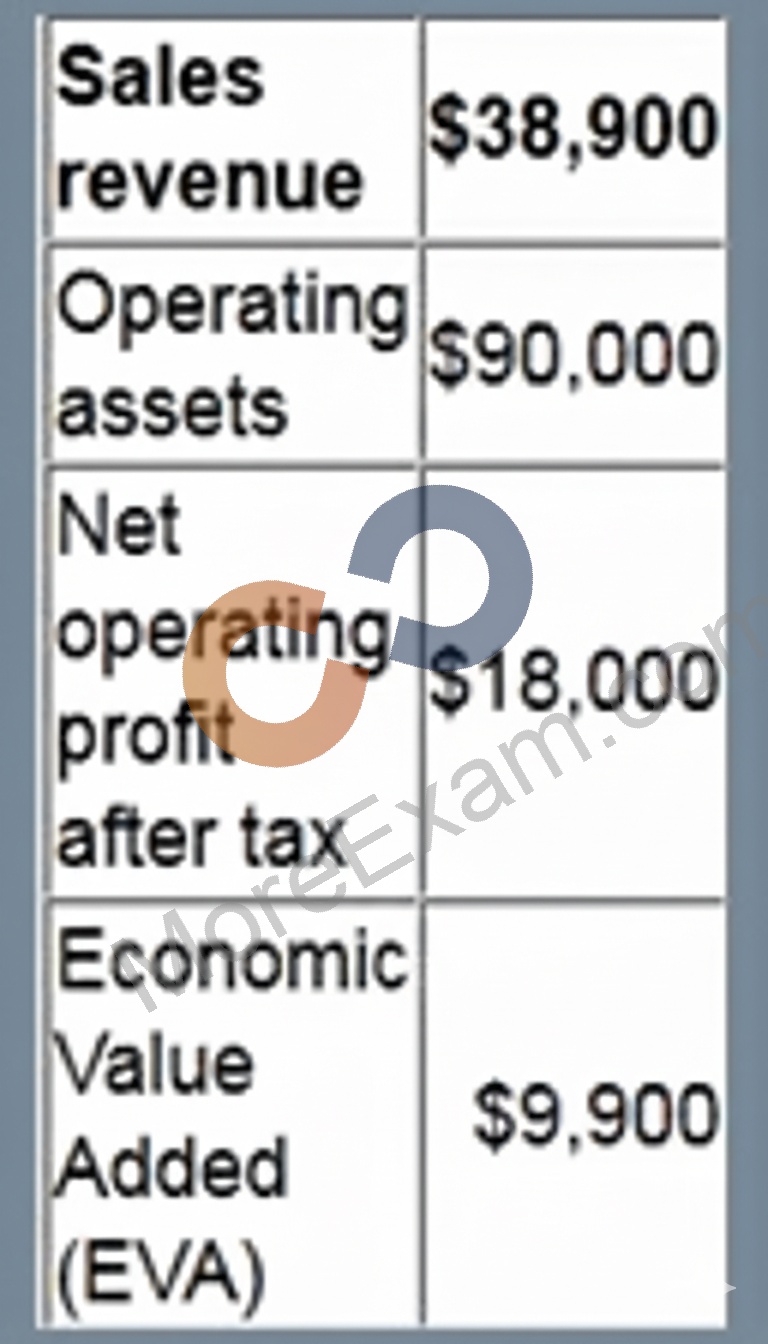
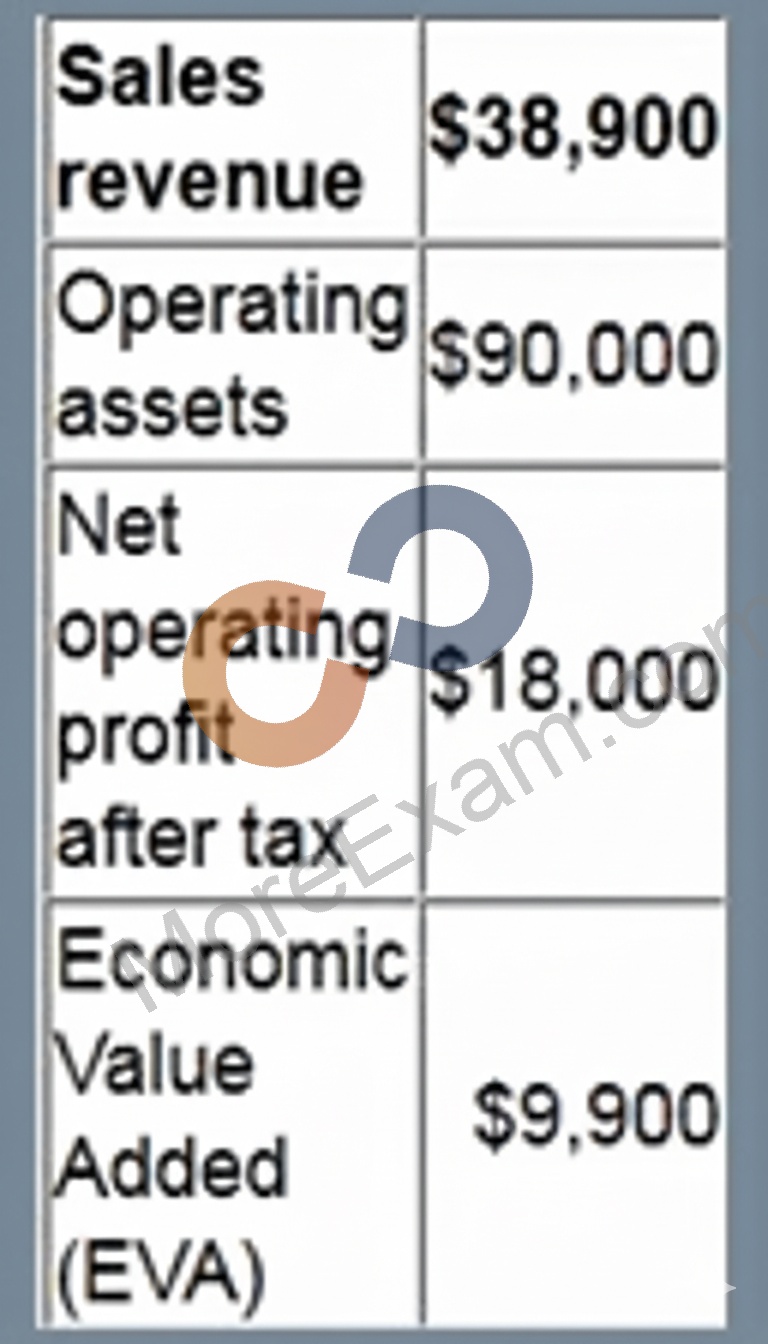
Question20: The following data are available for an investment centre for the latest period. Where appropriate the data have been adjusted to reflect economic values.What cost of capital has been used to calculate the EVA?Give your answer to the nearest percentage.
Question21: An organization is comprised of two divisions. One of the divisions manufactures a product that it sells both to an imperfect external market and to the other division.The organization wishes to establish the most suitable basis for the transfer price for this product and is considering either a negotiated transfer price or a market-based transfer price.Which of the following statements is correct?
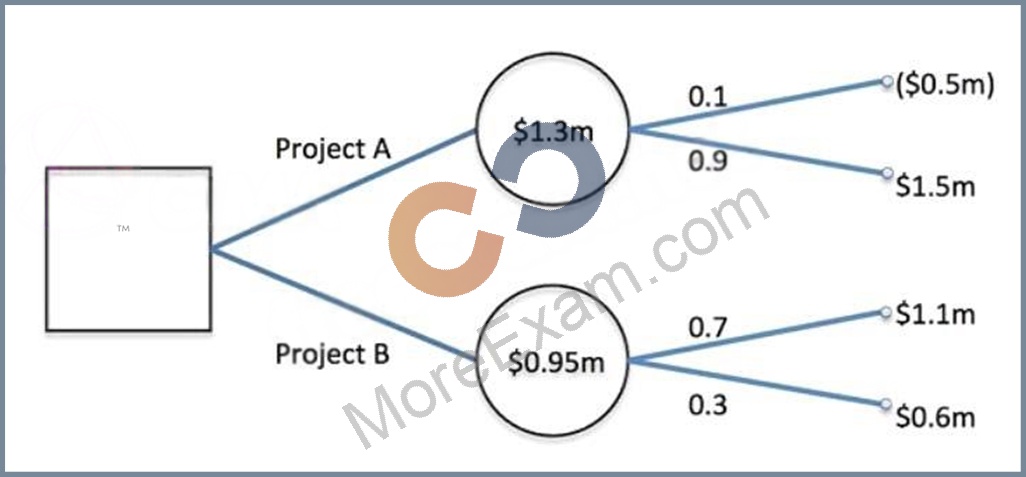
Question22: A company is deciding whether to invest in project A or project B. A decision tree has been prepared to illustrate the investment decision and its associated possible net present values (NPVs).Which of the following statements is correct?
Question23: Oliver owns a computer repair company. He is looking to close of of his departments as the demand for computer cleaning has dropped dramatically in the last 2 years and is no longer profitable.The contribution margin of the department is £12,000, and the overheads are £23,000 (out of which£4,000 cannot be eliminated).How would closing this department impact operating income?
Question24: The management of a leisure company, who are risk averse, have just approved an investment in a new amusement park. The country in which the amusement park will be located has a warm and mostly dry climate throughout the year.A number of specific risks related to this investment have been identified as follows.(1) Losses of very small amounts of revenue due to poor weather.(2) A significant financial liability may arise due to the injury of a member of the public.(3) Loss of several days of revenue due to rides being unavailable because of poor maintenance routines.(4) Income fraud as a consequence of the high levels of cash handled by employees.Using the TARA framework, which is the most appropriate way of managing each of these risks?
Question25: IOP's product is manufactured using a production process that is known to have a defect rate of 10%.IOP's quality control department has developed a test that has a 98% probability of classifying a non- defective item correctly and a 2% probability of classifying a non-defective item as defective.The same test has a 95% probability of classifying a defective item correctly and a 5% probability of classifying a defective item as non-defective.Calculate the proportion of IOP's output that will be classified as non-defective by the quality control department's test.Give your answer to one decimal place.
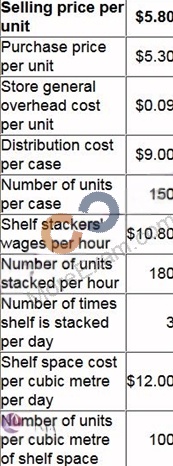
Question26: A large supermarket is applying direct product profitability analysis to establish the profit earned by each of the products it sells.Data for product P are as follows.The shelf is stacked each time that all units are sold and there are no units of product P left unsold at the end of each day.What is the direct product profit per unit of product P?Give your answer to the nearest $0.01.
Question27: Which of the following is the ideal basis to use for a transfer price when there is a perfect external market?
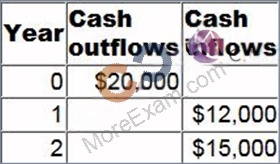
Question28: The cash flows from a project are detailed in the table below.To the nearest 1%, what is the project's internal rate of return?
Question29: A machine requires an initial investment of $500,000. The net present value (NPV) of the investment in the machine is $36,500.Which of the following statements is correct in relation to the sensitivity of the investment?
Question30: Which of the following statements are correct with regard to responsibility centres?Select ALL that apply.
Question31: A company is considering two mutually exclusive projects, an analysis of which is given below:The company's cost of capital is 12%.Assuming an objective of maximising shareholders' wealth, which project would be recommmended?
Question32: A company has invested $500,000 in developing a new product and requires a return of 12% on this investment.The company has researched the market and has set the selling price for the new product at $300 per unit. At this price, sales volume for next year is forecast to be 500 units. The forecast unit cost is $210.What is the target cost gap per unit for the coming year?Give your answer to the nearest whole $.
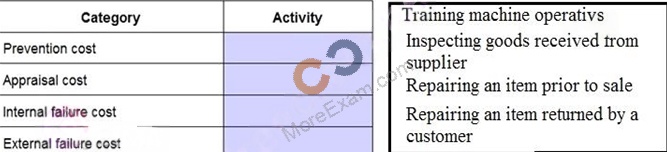
Question33: Place each of the activities described below against the correct classification of quality costs.
Question34: Company X is considering the launch of a new product. In order to compete in the market the selling price must be $100 per unit. Company X aims to achieve a sales margin of 25 per cent.Direct materials cost is $75 for each unit. It takes 15 minutes for workers to assemble each unit. Workers are paid $16 per hour. 5 per cent of paid time is idle. Overheads are absorbed at $6.50 per unit.What is the value of any cost gap between the forecast total cost and the target cost?
Question35: An organization wishes to make its investment decisions on the basis of more than simply a financial appraisal. Which of the following will assist it to take into account both qualitative and quantitative factors?
Question36: Which of the following is a key objective when agreeing a basis for setting transfer prices?
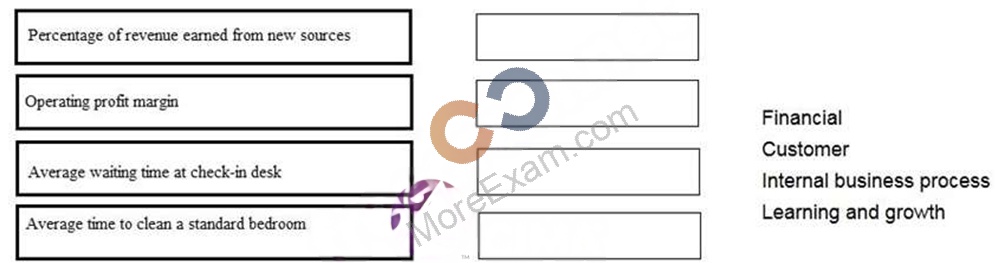
Question37: Place each performance measure against the correct perspective of the Balanced Scorecard for a company that operates a chain of hotels.
Question38: The following cash flows are forecast for a potential investment project.The cost of capital for the project is 12% per year and the company uses a straight line depreciation policy.What is the modified internal rate of return (MIRR) of the project?Give your answer to the nearest whole percentage.
Question39: Which of the following is a correct description of the key features of net present value?
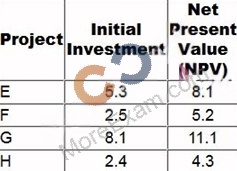
Question40: A company has a maximum of $2 million to invest and has identified four viable projects, E, F, G and H.The initial investment for each of the projects is the maximum amount that can be invested in the project, but any amount up to the maximum can be invested. The projects are divisible.The projects have been evaluated using net present value, as below. All figures are $ millions.In which project should the company invest $2 million?
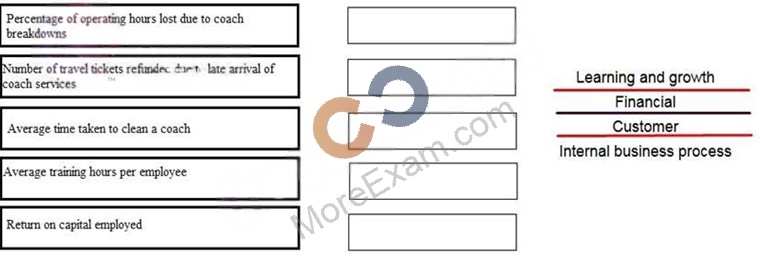
Question41: A Balanced Scorecard is being prepared for a coach passenger transport company. Place the correct perspective of the Balanced Scorecard against each performance measure.
Question42: SkillWeave are an international clothing manufacturer known for their durable and high quality products. Recently their biggest market in the world's premier customs union has had some economic volatility. This has resulted in the currency of this market being very unstable and difficult to predict in terms of whether it will retain, lose or gain relative value to domestic currency.Which of the following is an effective risk reduction technique for SkillWeave's clothing sales to this region?
Question43: Juan is looking to invest in the mining industry. He has narrowed his options down to two rival companies, both with sales of £200m. Company A has an EBIT of £10m whereas Company B has an EBIT of £14m.This would suggest that Company B is the better investment but Juan is suspicious that Company B has more financial backing than Company A.Which ratios will tell him which company will use his investment the best?
Question44: An organization employs a dual pricing basis for the transfer of components between its divisions. This means that:
Question45: The starting point for developing a balanced scorecard for an organization should be:
Question46: Endure Co. makes 1,000 units ofX and 2,000 units of Y.Costs for X: Material $4, labour $8, direct overhead $2, fixed cost $4.Costs for Y: Material $9, labour $9, direct overhead $4, fixed cost $6.Selling price for X and Y are S19 and $25 respectively. Another company can sell ready made product X and product Y's to Endure Co, this company sells X at $12 and Y at $21. Advise Endure Co. on what would be the most cost effective way to source products X and Y.
Question47: An organization wants to increase the use value that customers place on one of its products - a laptop computer.Which of the following actions, taken to increase the value to the customer, would increase the product's use value?Select ALL that apply.
Question48: A risk averse decision maker will:
Question49: A company's competitor has just launched a rival product at a selling price of $38 per unit. Until now the company's selling price of $41.60 per unit has achieved a 30% mark-up on the product's unit cost. The company proposes to use a target costing approach to pricing to remain competitive.Management has decided to match the competitor's selling price and has set a target cost to achieve a20% return on the target price.What is the cost gap?
Question50: In order to support decision making, management accounting information categorizes costs in a variety of ways.Responsibility accounting primarily distinguishes between costs on the basis that they are either:
Question51: A company is investing in a huge diversification project. The plan is to develop and sell a whole new product line that they have never sold before. They've already started a massive marketing campaign for this new product line and they are getting good feedback in their market research.They've had to use debt funding in order to finance the project, but they hope that the returns will be worth the investment and restructuring. If they are successful they will be a step ahead of all their competitors and offer something none of them can.What is the risk appetite of this company?
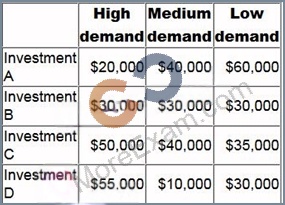
Question52: A company is considering four mutually exclusive projects. There are three possible future demand conditions but the company has no idea of the probability of each of these demand conditions occurring. The forecast net present values (NPVs) of each of the four projects, under each of the three possible future demand conditions, are as follows.Using the maximax criterion, which investment should be selected?
Question53: One of a company's products is sold to three customers: A, B and C. These customers do not buy anything else from the company. The product costs $20 per unit to manufacture and is sold to the customers for $50 per unit.The following table shows data for sales and selling costs for the latest period.Delivery costs of $32,000 and general overheads of $60,000 were incurred during the period.Deliveries to customers A and B were made by a courier in batches of 100 units; the courier charged$300 for each batch delivered to customer A and $400 for each batch delivered to customer B.Deliveries to customer C were made by mail in batches of 10 units at a cost of $60 per batch.Which of the following statements is correct?
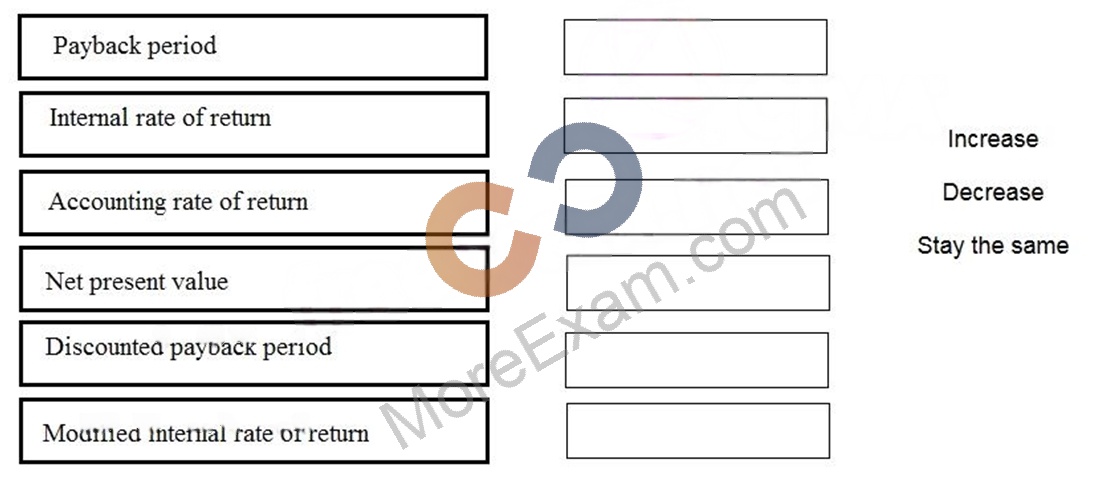
Question54: An investment appraisal has identified that a project has a positive net present value when discounted at the company's cost of capital. If the cost of capital is now increased, indicate whether each of the following appraisal measures will increase, decrease or stay the same.
Question55: A manager must decide which one of three projects should be implemented. For each project the possible outcomes and their associated probabilities can be estimated reliably. The manager has decided to make the decision based solely on which project has the highest expected value of profit.Which of the following statements are correct?Select ALL that apply.
Question56: Beyond Budgeting is essentially an approach that places modern management practices within a cultural framework. Analyze the following statements:1. The organization structure should have clear principles and boundaries.2. Managers should be given a high degree of freedom to make decisions.3. Frontline managers should be made responsible for relationships with customers.4. Information system should be transparent and ethical.Which of the above statements relate to Beyond Budgeting?
Question57: A manufacturing company has just developed a new product and must now determine the most appropriate pricing strategy for its initial launch.The product will initially be unique because it will include highly desirable features that no competitive product offers. Its development has involved substantial expenditure and the company wishes to recover this as soon as possible.The product's uniqueness is expected to last for only six months before a competitor launches a similar product. It is expected that the competitor will avoid any significant development costs by reverse engineering the company's own product.At that point, to remain competitive, the company must ensure that its selling price matches that of the competitor.Which of the following pricing strategies would be most suitable for the initial launch of the company's product?
Question58: A company is classifying its quality costs to prepare a quality cost report. Which of the following are conformance costs?Select ALL that apply.
Question59: The discount rate at which the net present value (NPV) is zero is known as the
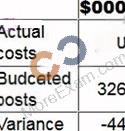
Question60: A cost centre manager's performance is monitored based on a comparison of actual and budgeted cost.A summary performance report for the latest period is shown below.The actual costs include:*$28,000 for allocated head office costs.*$18,000 payment for a rental agreement entered into by the cost centre manager two years ago.*$34,000 for depreciation.What is the cost centre manager's controllable actual cost for the period?Give your answer to the nearest $000.
Question61: An organization wishes to achieve cost reductions for a product it already has in production without affecting the customer's perception of the product.It has decided to carry out a systematic examination of the factors affecting the cost of the product in order to identify ways of achieving the specified purpose at lower cost while maintaining the required standard and quality.Which of the following correctly identifies the activity that the organization is undertaking?
Question62: An organization uses a balanced scorecard approach to performance measurement, both at the corporate level and to assess the performance of each of its responsibility centre managers.Which THREE of the following statements are valid in respect of the effect of this approach on the behavior of the responsibility centre managers?
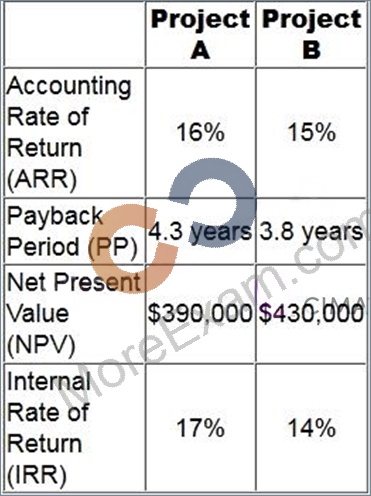
Question63: The directors of a company wish to evaluate two mutually exclusive capital investment projects. Both projects have conventional cash flows: an initial outflow followed by a series of annual cash inflows.The directors are aware of the following three investment appraisal methods: internal rate of return (IRR), net present value (NPV) and accounting rate of return (ARR).The directors have asked for your advice about which method should be used to evaluate these two projects.Which of the following is valid advice to give to the directors?